One holiday drop: the Puff one-gram in a hand-blown Jerome Baker tube, in a box worth opening. Same format, same wordmark up the side — in a piece they keep using long after the joint is gone.
Every one of these is a separate trip to the torch, which is why two tubes off the same bench are the same object and not the same piece. That is what a limited drop is actually selling.
A band of gold laid on at the rim and let go. It runs, thins, and ends in a marble where it stopped. No two are the same.
Stringers walked round the base while they are run up and down, stacked into chevrons - in the same pink and gold as the drips, so the two ends of the piece answer each other.
Every drip ends in one, walked right round the piece rather than set in a row down one side. To roll, the tube has to climb over one - so it stops however it lands.
Pressed into the glass on the face opposite the print. The piece is signed the way a piece of glass is signed.
4.5 mm of wall and 7 mm of base - about twice what it needs. That is not for the joint, it is so the piece survives being knocked off a counter for years.
You have the reach and the doors. We have been blowing glass since the nineties and a name people collect. Put those together in the one week of the year when people are buying an object instead of a price, and it is not a hard sell to anybody — small, finite, and easy to walk away from if it is not for you.
Twenty million pre-rolls and the doors that go with them. Nothing we make gets in front of that many people on its own.
Jerome Baker is opening doors in New York quickly right now. A drop across both states rides that in one of the two markets you are already in.
Holiday is the one stretch of the year when the question is what to give somebody, not what something costs. That is the whole reason this piece works.
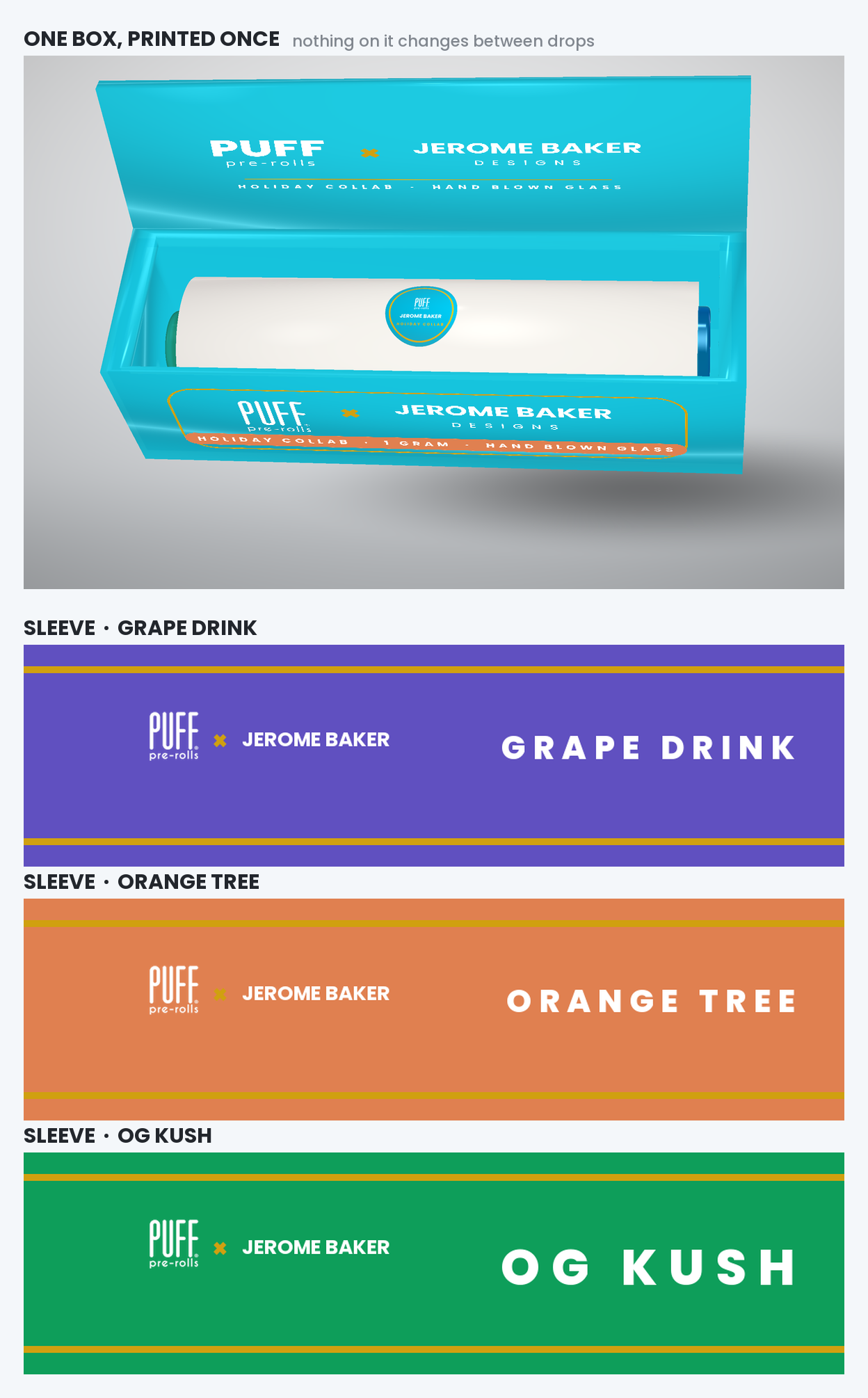
The lid is hinged full height and closes onto two disc magnets. It opens with a click, and it is the kind of box people keep things in afterwards rather than flatten and bin. Switch the viewer above to In the box to turn it over.
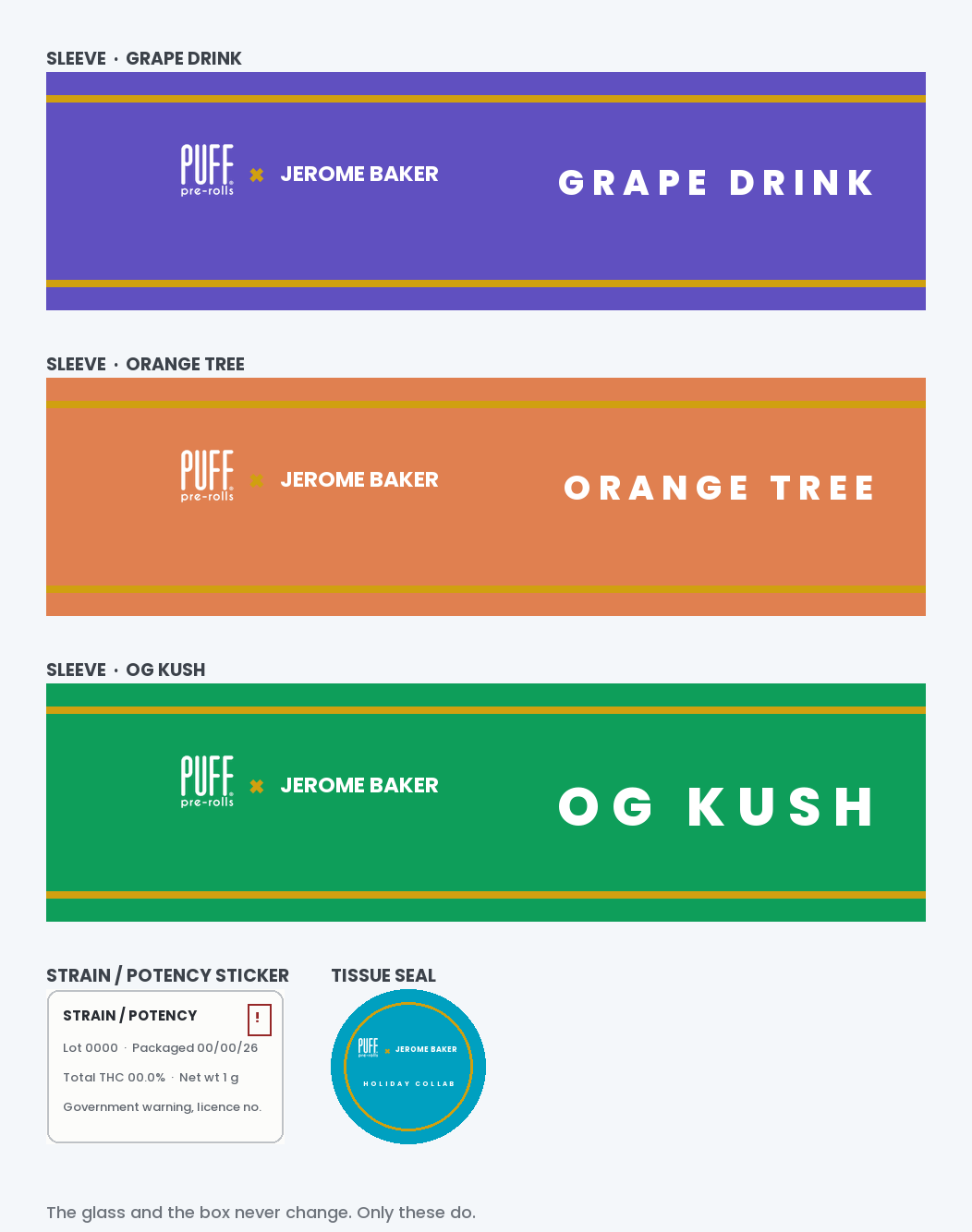
The piece is wrapped in branded tissue and closed with a sticker seal. No foam, no cradle — a box cut to the piece does not need anything holding it still, and there is nothing in it that cannot go in the recycling with the box.
44 × 48 × 157 mm. Just enough room for the tube and the tissue round it, which is cheaper to make, cheaper to ship and better to open.
The collab lockup sits on the board itself, foil-stamped rather than printed on a panel — the first thing seen when it opens. 53 × 52 × 169 mm, 3.5 mm board, wrapped inside and out.
Twenty million pre-rolls have gone out, and twenty million tubes have gone in the bin with them. That is the volume — and it is exactly why the opposite of it is worth doing once a year. Twenty thousand pieces that nobody throws away. From the day it is opened it is where they keep a joint: any joint, one of yours, one from somewhere else, one they rolled themselves. Every time they take one out, they are holding your name. You paid for that placement once, at Christmas, and it keeps working all year.
Nothing that changes is printed on the glass or the box. Two pieces of paper carry all of it — which means a second drop is a sleeve and a sticker, not a new product.


Printed once. No strain on it, no batch, no potency — so one run of board covers every drop there will ever be.
Slips over it. The strain and its colour, and the only thing that has to be reprinted to make a new drop.
Strain and potency, printed the week it is packed rather than the quarter before. The tissue seal closes the wrap.
On shelf for the gifting weeks, in California and New York, ten thousand a state. One piece, one finish, paired with a strain chosen for the drop and named on the box — allocated by door count into doors that already carry Puff. After it: the same piece, a new strain, a drop a quarter if the first one lands.
Capacity is in place for all three bands. The body and the decoration run as two jobs and the line is in place. Samples in hand inside three weeks of sign-off.
You already know the work, so there is nothing here to prove on paper. Strain, finish, artwork — you will want changes, and they are easier to make with the piece in your hand than in a meeting about it. Nothing to specify to start.